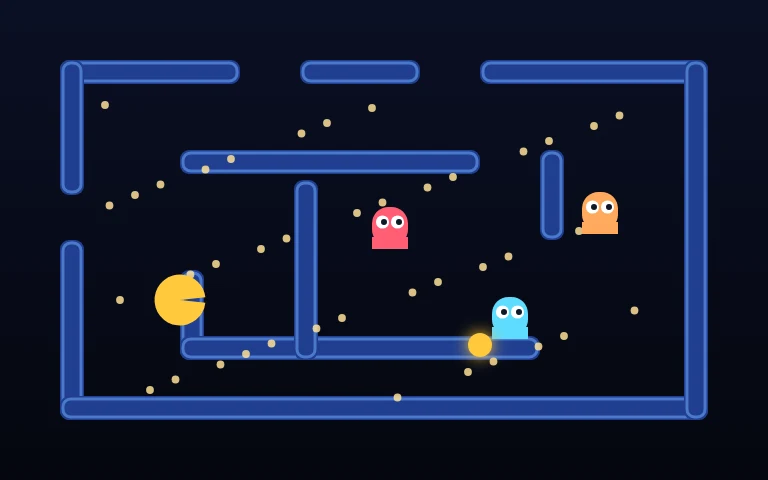
Most runs in a maze chase end the same way: the last pellet gets eaten with three guards closing from three directions, and the player panics into a pellet they should have saved. The fix is to stop treating the power pellet as a panic button and start treating it as a resource with a schedule.
Read the board before you commit
A pellet is worth roughly six to eight seconds of free movement, and that time converts into points only if there is something to eat during it. Before you take one, ask a single question: where are the guards, and where will they be four seconds from now?
If two guards are far away and one is near, eating the pellet turns the near one into points and leaves the far ones as a problem you still have to solve. If all three are clustered in the opposite corridor, the pellet buys you very little — you would have cleared that corridor anyway.
The tunnel is your reset button
Every maze of this kind has side tunnels that wrap the edges of the board. Guards slow down when they turn into them; you do not. That asymmetry is the single most reliable escape in the game, and it is usually wasted because players only use the tunnel when they are already trapped.
- Cross the tunnel on your normal route even when nothing is chasing you. It costs nothing and teaches you the exit timing.
- Never enter a tunnel with a guard already inside it from the other end. You will meet in the middle, which is the one place you cannot dodge.
- After a tunnel crossing, guards are on the wrong side of the board. That is the moment to eat a pellet.
Save one pellet for the last quarter
The endgame of every level is the dangerous part: few dots left, so you are forced into corridors you have been avoiding, and the guards have fewer places to be wrong.
The discipline that works is simple: do not eat the last pellet until the board is nearly empty. Hold it in your pocket, clear the safe dots first, then take the pellet, then sweep the remaining dots while the guards are edible. You trade one pellet's worth of safety for the ability to finish the level with a clear board instead of a chase.
Corner traps and how to avoid them
Guards in these games are simple: they chase, they turn at junctions, they mostly cannot reverse. That means corners are where they get you, because a corner removes two of your four exits.
A corner is not a hiding place. It is a place you can only leave in one direction.
When you are being chased toward a corner, turn early — take the junction one square before the corner even if it is a detour. Two seconds of detour beats losing a life.
A practical routine
- Clear the outer ring first, where the tunnel is available.
- Keep one pellet in reserve once half the board is gone.
- When a guard commits to your corridor, go around the block instead of straight back.
- Spend the reserve pellet when three or more dots remain in a single dangerous corridor.
None of this requires fast reflexes. It is entirely about sequencing — which is why patient players clear more levels than twitchy ones in this genre.