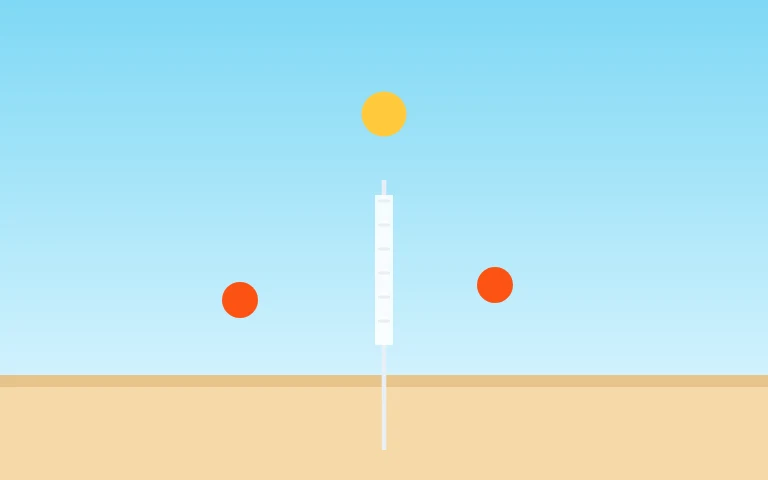
Beach Volleyball removes the hard part of volleyball and keeps the interesting part: you only move, and the game translates your position into shot quality. Once you internalise that translation, the sport becomes geometry.
The position-shot dictionary
Your player bumps the ball automatically, and the return type follows from where you contact it:
- At the net: flat, fast, low over the tape. Hard for the opponent to run down.
- Mid-court: a normal arc with some depth.
- Deep: a high, soft lob that buys time but gives the opponent an easy set.
None of these is chosen with a button. They are chosen with your feet, two seconds earlier.
Live a step off the net
The flat return from the net is the best shot in the game, which suggests camping at the net. It also loses, because a ball landing just behind you forces a deep, weak lob — exactly what the AI likes to punish.
The winning zone is one step off the net: close enough that most contacts are flat and aggressive, deep enough that the short ball is still reachable with a flat-ish return. From there, both outcomes stay dangerous.
Pick the position where your worst likely contact is still a decent shot. That is your home.
Return to the middle after every contact
After each bump, walk back to the centre of your zone before watching where the ball goes. The centre is the only place that reaches both corners in time; wherever you drifted for the last contact is the worst place for the next one.
The rhythm is: contact, recover, read. Players who watch the ball sail and then scramble lose every third ball to their own feet.
Read the arc early
The lob's landing point is readable the moment it crosses the net — judge the apex, not the ball. Move on the apex. Waiting for the descent means arriving late, arriving late means a deep contact, and a deep contact is the weak lob that starts the next attack against you.
Playing to seven
Rally scoring means the marginal point matters more than style. When leading, stay in the home zone and let the opponent earn their errors. When trailing, take half a step toward the net: flatter returns create pressure errors even when they land long occasionally. The AI defends loopy balls comfortably and flat ones badly — that asymmetry is how comebacks are built.