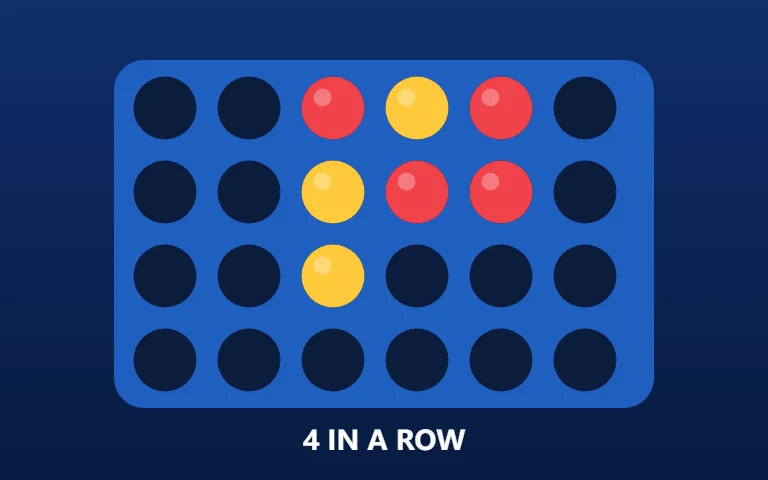
Connect Four looks like a children game and plays like a threat-management exercise. Every disc you drop creates threats and blocks threats at the same time, and the player who sees two threats at once wins.
Why the centre matters
The middle column touches more possible four-in-a-rows than any other: three horizontal lines, three vertical, and the two longest diagonals. That is why the standard opening is centre, and why giving up the centre without a reason is usually a slow loss.
But the centre is only an advantage while the board is empty. By move six, the value of a column is decided by the discs already in it, not by its position on the board.
Threats come in two kinds
A single threat is one disc away from four. Your opponent blocks it, and the game continues. A double threat is two separate winning squares that cannot both be blocked with one disc — that is the actual win condition.
The practical goal of every move after the opening is to create a double threat, or to force your opponent into giving you one. Single threats are just tempo: they make the opponent spend a move where you want them to.
Building a double threat
The classic shape is a diagonal pair with a gap, plus a horizontal pair on the same square. When you place a disc that completes one line, the square that completes the other is already open and unreachable by a single block.
Two patterns worth memorising:
- The split pair: two discs of your colour with one empty cell between them, on a row that has space on both sides. Fill the gap and you threaten both directions.
- The stacked diagonal: three discs forming a diagonal with two open ends. Blocking one end leaves the other.
Do not fill the column you need
A common self-destruct: you build a vertical threat in a column, your opponent blocks above it, and now that column can never take another disc for you. Before stacking, check whether you will need that column later as a drop route.
Playing from behind
If the opponent has the centre and one more threat than you, stop attacking and start restricting. Occupy the squares that would complete their diagonals, even if the disc does nothing for you. A move that removes two of their threats is worth more than a move that creates one of yours.
Against a computer opponent
A perfect opponent never loses from the standard opening, so the realistic target is a draw. Two things help:
- Never create a double threat for the opponent by dropping into a column that already has two of their discs in a diagonal.
- Prefer moves that keep your options in the centre three columns. Forcing the game to the edges usually favours the player with better pattern recognition, which is not you against a machine.
Take the draw when it is offered. Against perfect play, a draw is the win.