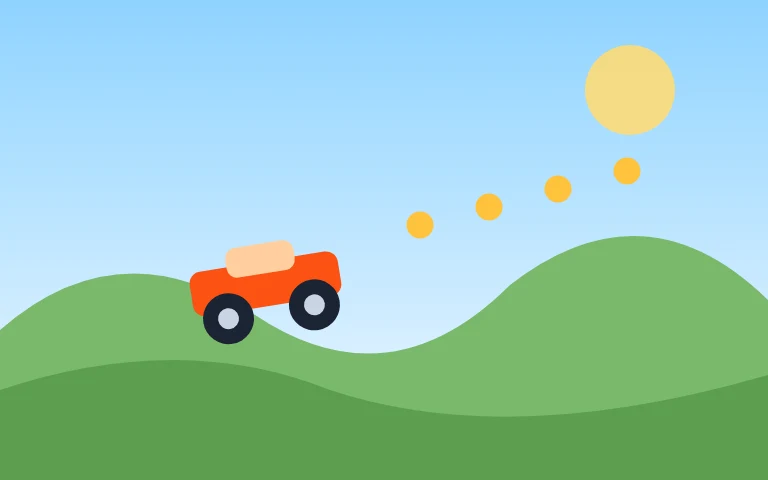
Hill Dash is a physics toy with a finish line. The car has momentum, the terrain is uneven, and the two ways to lose are flipping over and running dry. Both are throttle problems.
Momentum is not speed
On flat ground, holding the throttle is efficient. On hills it is a liability: the moment you leave a crest, your speed becomes airtime, and airtime is where the car rotates out of control.
The rule is to arrive at a crest slower than you think you need. You can always add speed downhill; you cannot take back a bad rotation.
Brake before the crest, not on it
Braking on the crest is too late: the wheels unload, the brake does nothing, and the car flies. Braking just before the crest keeps the wheels loaded and gives you a controlled entry.
If you are already airborne, do not fight it. Hold the car level with the throttle — a small forward input rotates the nose down, which is usually what you want for landing.
Feather, do not hold
Tapping the throttle in short pulses gives you the same average speed with far better control on rough ground. It also keeps the front wheel down, which is what prevents the backward flip that ends most runs on steep climbs.
On a long climb: pulse the throttle, release when the nose lifts, pulse again. Holding it down on a steep hill is how you end up on your roof.
Fuel is a route decision
Fuel cans are placed to reward a specific line, not the fastest one. If a can is off your natural path, ask whether the detour costs less than the fuel it saves — usually it does, because running dry ends the run outright.
Two habits:
- Never pass a can that is on your line, even with a full tank.
- When low, drive the smooth line rather than the fast line. Slipping and spinning burns fuel without distance.
Landing
Land with the wheels down and the car pointing along the slope, not across it. A landing across a slope immediately starts a roll, and a roll costs more speed than any brake would have.
If the landing looks bad, use the throttle to rotate the nose toward the downhill direction before contact.
A clean run looks slow
Watch a good run and it looks almost cautious: short pulses, early braking, smooth arcs. The time is not made at the crests, it is saved by not flipping, not stalling, and not missing fuel.
Speed is what you get for free once you stop fighting the terrain.