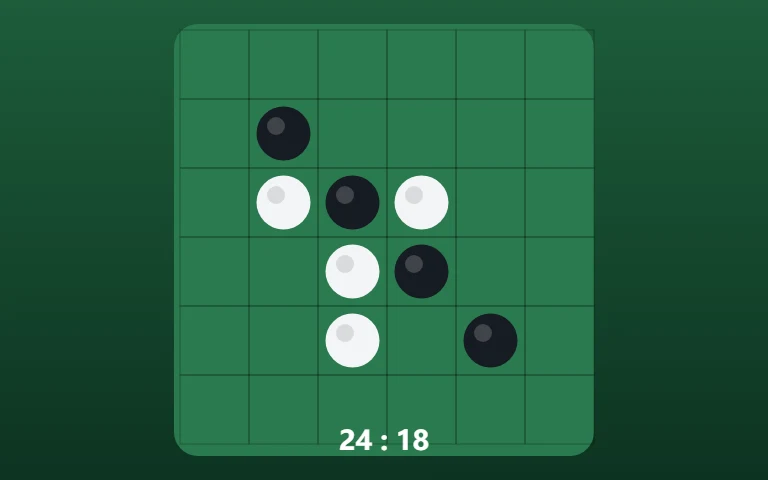
Reversi looks like a game of capturing territory, and it is — backwards. The counter-intuitive truth that separates beginners from players: the person with fewer discs in the middle game is usually ahead, because fewer discs means fewer flip targets and more move options later.
Discs are liabilities
Every disc you place can be flipped. Taking six discs with one move feels dominant and is often a disaster: you have built a long, thin line that your opponent can flip wholesale next turn.
The good moves in reversi are usually small ones — flips of one or two discs that keep your shape compact and your frontier quiet.
Mid-game you are not trying to win the board. You are trying to make the board annoying for your opponent.
Corners are forever
A corner disc can never be flipped: nothing surrounds it. Once you own a corner, discs adjacent to it along both edges become anchors that feed off the corner's stability.
This defines the entire strategy:
- Do not play squares adjacent to empty corners (the X and C squares in edge notation) — they hand your opponent the corner.
- Do take a corner whenever it is offered, no matter what it costs elsewhere.
- Quiet edges beat loud centres. Edge discs flip rarely, and edges lead to corners.
Mobility is the real score
The hidden metric in reversi is the number of legal moves each side has. The player with more options dictates the game; the player with one legal move must hand the board over.
You increase your mobility and cut theirs in the same way: keep your discs interior and compact, and let your opponent build long frontier lines. Every disc on their frontier is a flip you can make and a move they cannot.
Reading the endgame
The last eight to twelve empty squares decide the game, and here the strategy inverts: parity matters. Count who must move first into each region of empties.
- If a region has an even number of empty squares, the opponent plays there first — good for you.
- Odd regions hand the first move to you — often a liability late, because you open a flipping cascade.
When you can, play moves that make the remaining empties come out even in your favour. This one habit decides close games more than any tactical flip.
A practical opening
Play quietly: avoid X/C squares, keep discs grouped, accept being behind on the count. The board will look bad for ten moves — that is the game working. Then take the first corner offered, and watch the edges flip your way in chains.
Reversi rewards the player who is comfortable losing the scoreboard right up until the move that cannot be answered.