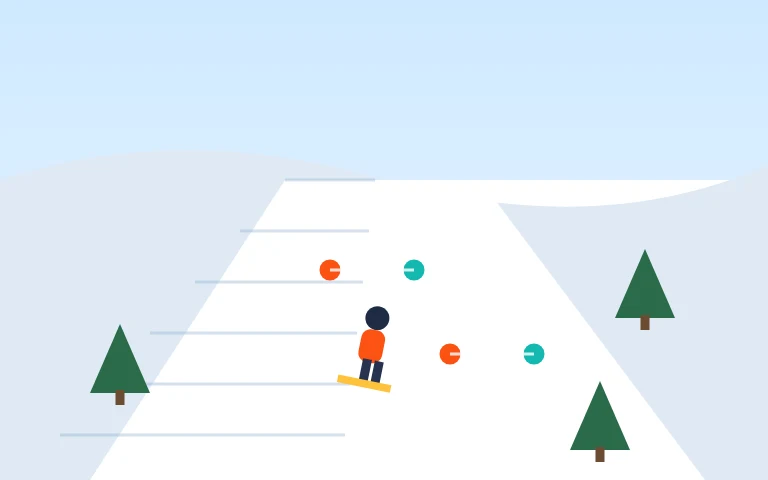
Ski Master pays for gates and punishes swerving, and those two facts fight each other in every beginner run. The resolution is a different mental model: you are not chasing flags, you are skiing one long line that happens to pass through some of them.
Ski a line, collect what it crosses
Decide your line — a gentle, wide curve down the hill — and take gates that lie near it. This inverts the usual logic: instead of steering to each gate, you steer almost never, and gates come to you.
The scoring consequence is smaller than you fear. Missing a gate costs a few points; one swerve into a tree costs the run. Over any meaningful distance, calm lines outscore gate-chasing.
Flags are income. Trees are debt. Never take debt to chase income.
Steering has a cost curve
Your skis respond quickly, but the mountain accelerates, and at speed every steering input is also a risk input. The real currency is how often you steer, not how hard.
Rules that hold:
- Make one smooth steer per obstacle, early, instead of three corrections late.
- Prefer lines that keep trees on one side at a time; weaving between single trees is the highest-risk pattern on the mountain.
- When two gates sit on opposite sides, choose the one that continues your current curve. The gate you can reach without changing direction is worth more than the closer one.
Trees telegraph, gates do not
Trees spawn in clusters with gaps you can read from a distance; gates are single points. Read the clusters first and route through their gaps — the gates near your route are bonus income, the ones far away are not yours.
New players read gates first and trees late, which is exactly backwards: the tree is the thing that can end the run, so it gets priority in attention.
Speed management without a brake
There is no brake button, so speed control is geometric. Wide arcs across the slope burn distance and effectively slow your descent through danger zones; straight-lining maximises both speed and exposure.
Use straight sections to bank points on flat, empty stretches, and open your arc wide whenever the next screenful is cluttered. You are not slowing down — you are buying room with geometry.
The crash check
One crash ends the run, so the endgame discipline mirrors the start: as speed climbs past what you can read, stop taking near-miss gaps and prefer the wide, boring side of every choice. The mountain pays survival first; style is a rounding error.