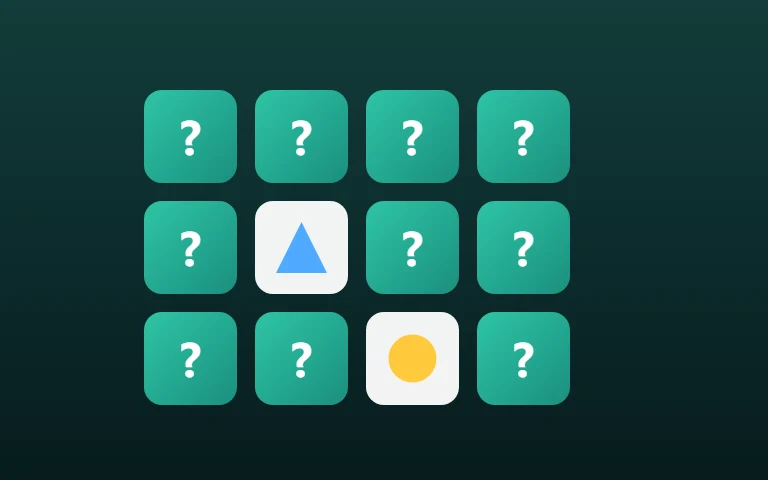
Memory pair boards feel like a pure memory test, and they are not. Strong players do not remember more; they organise what they saw better, and they open cards in an order that pays twice.
The first pass is reconnaissance
When a board opens, the first few flips are worth more than later ones. A pair found in the opening costs almost nothing; the same pair found late costs a wasted flip pair.
So the opening should be a quick sweep of new positions, not a hunt: flip two unseen cards, note them, move on. Even if nothing matches, you have bought information that pays later.
Encode position, not identity
"I saw the star somewhere upper-left" is not memory, it is fog. The format that works is a grid with coordinates in your head:
- Split the board into a small number of zones (quadrants, or rows).
- Store each seen card as shape + zone: star, top-left; moon, bottom-right.
- If the board is large, only bother storing cards you are likely to pair soon.
Human spatial memory is genuinely strong — you can recall where something was long after you forget what it was. Use the spatial channel deliberately instead of hoping images stick.
Never flip one known card alone
The core rule of efficient play: every flip should either find a pair or become knowledge you will use within two turns.
Flipping a card whose match you do not know is only justified when no known pair exists. The moment you hold two known cards of the same shape, take them — a known pair in hand is always better than one more scout.
The classic leak: holding one known star, spending turns hunting its match while other confirmed pairs sit on the board. Take what is banked first.
Count the shapes
Each cleared board adds a row, and boards get bigger. One habit scales with them: after your first sweep, count how many distinct shapes you saw. A board with eight shapes and thirty-two cards holds four of each — which tells you whether a "duplicate" you noticed is a pair or a shape you misremembered.
When two memories conflict, the count wins. Shapes never appear more or less often than the arithmetic allows.
Endgame cleanup
The last few pairs are the cheapest: by then most positions are known. The mistake is playing the endgame like the opening — random flips out of boredom. Spend five seconds reconstructing the grid before each flip in the final third, and boards that felt long finish fast.
A calm game
Nothing here is timed. The score is moves, and moves are a direct function of how carefully you convert flips into structured memory. Slow is literally the fast way.