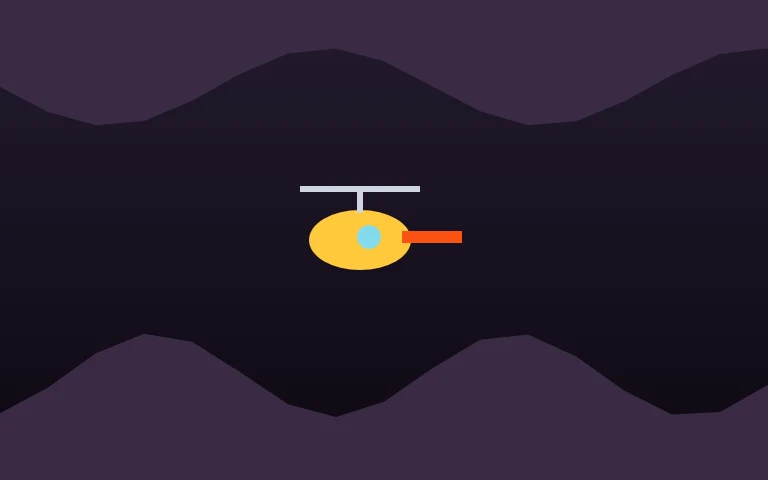
Cave Copter is the purest one-button game on this site: hold to climb, release to fall, survive an endless narrowing cave. Because there is only one input, every death is a throttle decision made slightly too late.
The hover point
Holding does not launch you upward; it adds lift against gravity. Release does not drop you; it removes lift. Between those two states is a hover — the point where you tap in a rhythm that holds one altitude.
The first skill is finding your hover: tap-tap-tap in short bursts and feel the helicopter stay level. Everything else in the game is moving that hover up or down.
- Need to rise over a ridge? Shift the hover up — slightly longer holds, same rhythm.
- Need to sink under a shelf? Shift down — slightly longer gaps.
The mistake is switching between "hold" and "release" as two modes. They are one mode, and the only variable is the ratio.
Fly the middle of the corridor
The cave punishes both walls equally, so the correct line is always the centre of the local corridor, not the centre of the screen. When the cave narrows, centre-line flying buys you equal margins on both sides.
When the corridor bends, aim for where the middle will be, not where it is. The scroll carries you forward; your only job is to be in the middle of whatever comes next.
Descend on purpose
Most deaths happen while descending, because falling feels safe until it suddenly is not. Gravity is faster than lift: every second of release is velocity you must buy back with hold time.
The rule: never descend faster than you can cancel in one second. If a shelf demands a steep drop, do it in steps — release, catch, release, catch — and arrive under the shelf with hover control instead of falling past it.
You cannot steer while falling. Every drop is a loan against your next hover.
The narrowing
The cave narrows with distance, which means the margins that felt generous at the start are gone by mid-run. The adjustment is not faster inputs; it is smaller ones — shorter taps, finer hover shifts. Big inputs in a small cave convert directly into wall hits.
Watch the cave, not the helicopter
Your eyes should be one screen ahead, reading the shape that is arriving. The helicopter stays in peripheral vision; by the time you can see it clearly, it is too late to change anything. This is true in every one-button flyer, and it is the difference between reacting and flying.