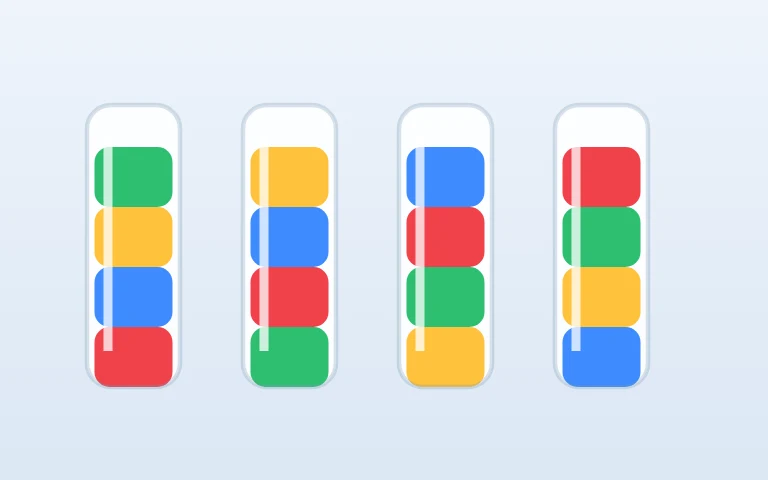
Water Sorts has two rules: you may only pour onto the same colour or into an empty tube, and only if the receiving tube has room. Those two rules make empty tubes the most valuable thing on the board — and the thing most players burn first.
Why empties are not "free space"
An empty tube can receive any colour. That makes it a universal buffer: it is the only place where a colour can wait while you dig out the colour underneath it.
Once you fill it, you have replaced a universal buffer with a specific one. Do that three times and the board has no flexibility left, even though it looks tidy.
The board is not solved when it is tidy. It is solvable while you still have somewhere to put a colour you do not want yet.
Pour in blocks, never in singles
Since you can only pour onto the same colour, a move always transfers the top block of one colour. A pour that moves one unit is almost always worse than a pour that moves three, because it costs the same move and the same destination space.
Before every pour, look down the source tube: how many units of that colour are contiguous at the top? If the answer is one, look for a different move first. If no other move exists, a single pour is fine — but it should be a last resort, not a habit.
Work from the bottom up
The most common dead end: you complete the top of a tube, then discover the colour underneath needs a destination that no longer exists.
Invert your thinking. Ask, for each tube, what is the colour at the very bottom, and where will it go? That colour is the one that has to travel furthest, so it should get the destination space reserved for it first.
- Tubes with two colours stacked are easy: one move reveals the bottom.
- Tubes with alternating colours are the expensive ones. Handle those while you still have two empties.
- A tube with the same colour at both ends is a trap: it looks nearly done and it is actually a wall.
Sequencing check
Before you pour, run three questions in order:
- Does this pour complete a tube? If yes, do it — a completed tube is one more free space.
- Does this pour expose a colour that has an obvious home? If yes, do it.
- Does this pour fill my last empty tube? If yes, stop and find something else.
Question three is the one people skip, and it is the one that ends runs.
When you are stuck
If no legal move helps, you are not stuck — you are one move away from being stuck, and the right response is to undo. Pouring randomly in a colour-sort puzzle does not create information; it destroys it.
Reset to the last known-solvable state and try the move you rejected earlier. The rejected move is usually the one that spends an empty — and that is exactly why it was correct.