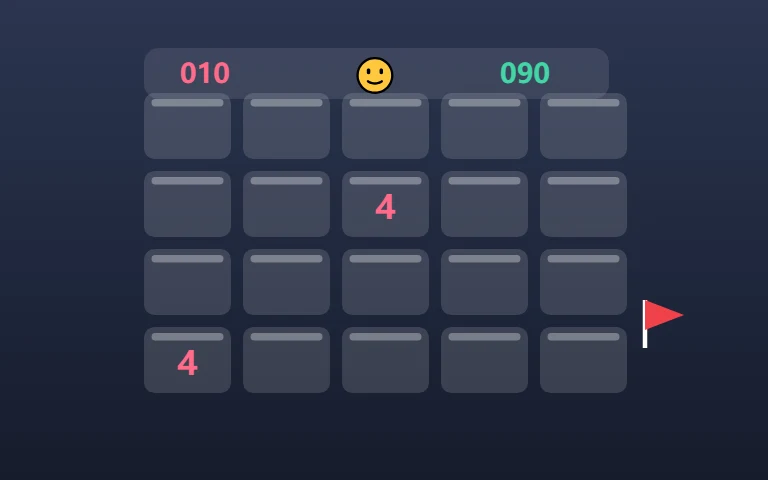
Minesweeper is a pure information game with one exception: sometimes the board genuinely does not contain enough information. Everything else is deduction, and deduction is teachable.
What a number means
A number is a constraint: exactly that many mines among the eight surrounding cells. That is all. Every technique below is just combining constraints until only one arrangement survives.
The 1-2-1 pattern
Three consecutive numbers of 1, 2, 1 on a flat wall, with unopened cells below, is the most common free solve on any board. The 2 touches both outer cells and the middle cell. Because each 1 can only be satisfied by one mine, the mines sit directly under the two 1s, and the cell under the 2 is safe.
Flip it for 1-2-2-1: the mines sit under the 2s and the outer cells are safe.
The 1-1 wall
A single 1 against a wall with exactly one unknown neighbour means that neighbour is a mine. Two consecutive 1s sharing the same unknowns mean the unknowns at the overlap are mines and the rest are safe. This is the pattern that opens most starting boards.
Working from the frontier
Never click a random cell while a frontier exists. A frontier is any opened number that still touches an unopened cell. Process frontiers in order of how constrained they are — a number with one unknown neighbour is a certainty, a number with five is a coin flip.
Clear certainties first, and the new information often resolves the previously ambiguous cells without any guessing.
Counting the whole board
At the endgame, the mine counter is a constraint too. If the counter says two mines remain and a frontier needs exactly two, every other unopened cell on the board is safe. Players forget this constantly and guess when the board has already told them the answer.
When it is genuinely 50/50
Sometimes two cells are symmetric with respect to every number touching them. No amount of logic distinguishes them. Recognise it early:
- If two unopened cells touch exactly the same set of numbers, they are interchangeable.
- If the mine count forces one mine across a pair, and both cells have identical constraints, it is a coin flip.
In those cases, click the cell that gives the most information if you survive — usually the one with more numbers around it — and accept the loss if it is a mine. Tilting after a forced guess is how good runs end early.
Speed comes from pattern recognition, not clicking fast
Experienced players are not faster at arithmetic; they recognise 1-2-1 and 1-1 walls instantly and spend their thinking on the two or three genuinely hard spots per board. If you want to get faster, drill the patterns on small boards until they are visual, not verbal.
A short checklist
- Open the frontier with the fewest unknowns first.
- Apply 1-2-1, 1-2-2-1 and 1-1 walls before anything else.
- Use the remaining mine count before guessing.
- If two cells are symmetric, guess the more informative one and move on.
The game rewards patience exactly once per board, and then it rewards speed.