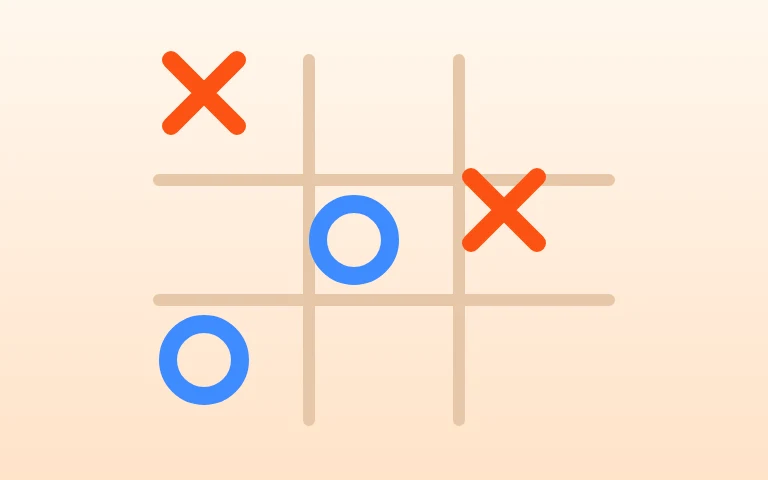
Tic Tac Toe has 255,168 possible games and exactly one correct result: a draw. That is not a disappointing fact, it is the strategy. Once you know it, the game becomes a search for the opponent mistake.
The opening is a corner
Corner first, centre second, edge never. A corner opening creates the most forks; an edge opening creates none. If the opponent opens in a corner, the only move that does not lose is the centre.
If they open in the centre, take a corner. If they open on an edge, take the centre and you are already safe.
Blocking is not enough
Most players play reactively: they see two in a row and block. That guarantees a draw at best and loses to a fork. The correct question after every opponent move is not "what must I block" but "if I ignore the block, what can they do next".
A fork is two threats at once. You cannot block both. Preventing a fork means occupying the fork square before the opponent can use it, which is often a quiet move that looks like it does nothing.
The three fork squares
On an empty board, the squares that create forks are the four corners. That is why corner play dominates. The classic trap: you take a corner, the opponent takes the centre, you take the opposite corner. Now every edge square you own creates a fork — and the opponent has to play perfectly to survive.
Against a perfect opponent
Your game cannot win. The realistic goals are:
- Force a draw from the opening.
- Punish the one class of mistake a simple AI still makes: blocking a threat instead of preventing a fork.
If the computer takes the centre first, take corners and mirror its moves. Mirroring is the simplest drawing strategy: whatever square it takes, take the rotationally opposite one.
Why this matters beyond the game
Tic Tac Toe is the cleanest demonstration of a solved game: perfect information, no randomness, finite tree. Every strategy is a lookup, and the lookup says nobody wins.
That is also why it is a good teaching tool. The same reasoning — check the opponent threat tree, not just the immediate threat — is exactly what Connect Four and chess endgames require, with more squares.
A short checklist
- Corner first, centre second.
- Answer a centre opening with a corner.
- Before blocking, ask whether a fork exists.
- If nothing else works, mirror.
You will draw almost every game. That is the win condition.