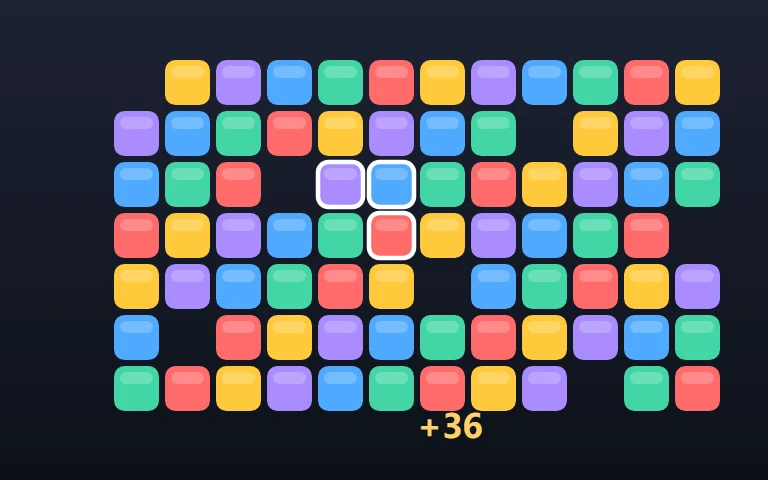
Remove Block is one of the few casual puzzlers where the scoring rule is visible and exploitable: points scale with the square of the group size. That single sentence rewrites the entire strategy.
The arithmetic
A group of five scores roughly twenty-five units. A group of ten scores a hundred — four times as much, from only twice the blocks. Two groups of five, removed separately, score fifty.
So merging two groups into one doubles your score for the same number of blocks. Ten blocks removed as a single group are worth twice what the same ten blocks are worth in two groups.
This has a direct consequence: you should almost never remove a group just because you can. You should remove it when removing it enables a bigger merge, or when the board is running out of moves.
Build bridges, not piles
The board collapses downward when you remove blocks, and columns fall into the gaps. That collapse is your merging tool: it can bring two same-coloured groups together that were previously separated by a vertical wall.
Look for columns where the same colour sits above and below a different colour. Removing the middle colour drops the top part onto the bottom part. If both parts are large, that single removal can create the biggest group of the board.
- Removing the *middle* of a column merges top and bottom.
- Removing the *bottom* of a column merges nothing — it only shifts weight.
- Removing a *horizontal* band is usually the weakest move on the board.
Preserve the biggest colour
At any moment one colour is your best asset. Removing it in small pieces destroys the group you were building.
A workable heuristic: keep the largest colour group untouched until either (a) it can absorb an adjacent group of the same colour, or (b) the board has no other legal move that grows anything.
The board does not punish you for leaving blocks. It punishes you for leaving no moves.
Watch the move budget
Some board clearers end when no group of two or more remains. That is the real failure state, not a timer. So the last third of a board should be played defensively: keep two separate groups of the same colour on the board as long as possible, then merge them at the end.
Two groups of three, merged at the very end, are worth more than the same six blocks taken one group at a time — and they keep you alive longer, because they keep legal moves on the board.
A practical order of play
- Scan for a column where one removal would join two same-coloured masses.
- Take it, then take the big group it created.
- Leave the largest colour alone unless it can grow.
- In the endgame, merge your reserves instead of clearing them.
The whole game is one question asked repeatedly: is this removal making the next group bigger, or just making the board look cleaner?