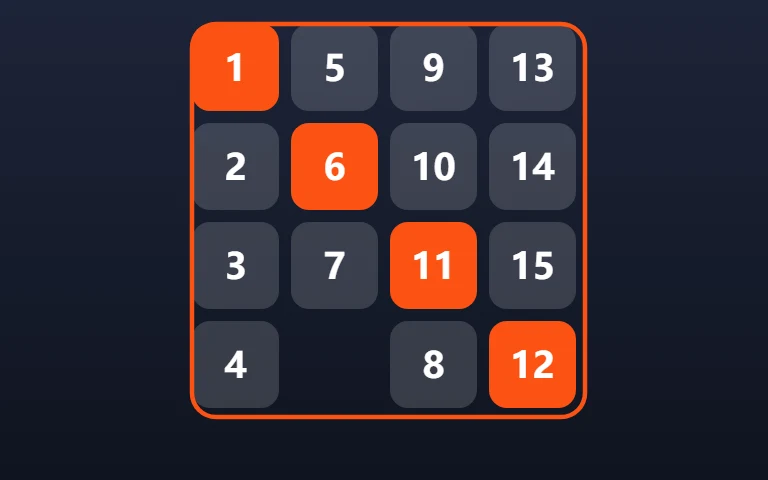
The fifteen puzzle is one of those games where the winning method is not obvious and random sliding never, ever solves it. The classic method divides the board into phases.
Phase one: the top row
Place tiles 1, 2, 3 one by one — the top row is forgiving because nothing above it can be disturbed. Only tile 4 (the corner) is tricky: bringing it in directly often strands it.
The corner technique: position tile 4 directly below its target square, position tile 3 to the left of tile 4, then rotate the little 2x2 square containing both until both settle. Never slide tile 3 into place first and hope for room.
Phase two: the second row
Same idea: place 5 and 6 freely, then pair 7 and 8 into the corner using the same rotate-the-2x2 trick, one row further down.
After two rows are locked, the remaining bottom two rows must be solved without moving the locked rows — which is why the top-down order matters. Every phase shrinks your working area on purpose.
Phase three: the last two rows
With two rows left, stop thinking tile by tile. Arrange the bottom region so that:
- The left column finishes as a column (9 over 13, 10 over 14), and
- The final 2x2 (11, 12, 15 and the gap) can be cycled into place.
If the last 2x2 arrives in the wrong cyclic order, cycle it — the three tiles and the gap can rotate among themselves, and only the correct rotation solves it. This is the step where players who placed everything else correctly still fail, and the fix is always the same: keep cycling, do not scatter the region to "fix" one tile.
The blank is a tool
Beginners treat the empty square as an obstacle. It is the only worker on the board: every move is the blank moving. When stuck, ask where the blank needs to be for the tile you want to move, and route the blank there first.
You never move tiles. You move the gap, and tiles happen.
Trust solvability
This version guarantees every deal is solvable, which means a stuck position is always a mistake in method, not a dead board. The practical recovery: instead of undoing many moves, re-solve the disturbed region from its current layout — the method above works from any layout, not just fresh ones.
The practice loop
Solve three boards with one rule: never place a tile that disturbs a locked row. You will get stuck and restart a few times, and then the phase structure stops being a method and becomes how you see the board.