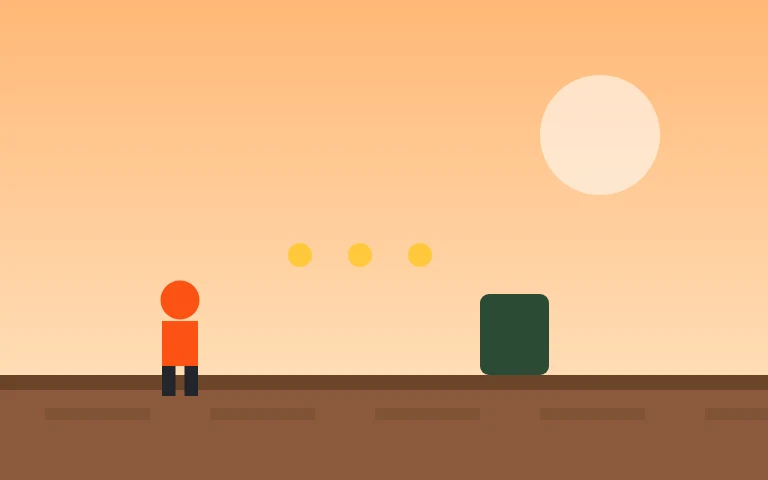
An endless runner with one hit point is a game about removing actions, not adding them. Every jump has a cost: while you are airborne you cannot adjust, and you cannot jump again. So the central skill is deciding which obstacles do not need a jump at all.
Learn the two obstacle families
Obstacles come in two behavioural groups, and they have opposite answers.
- Low and flat — crates and similar blocks. These are cleared by a jump, and the correct timing is late: jump when the obstacle is close enough that you land just past it. Jumping early means you land on it.
- Ground-level hazards — spike strips and similar. These punish being on the ground, not being in the air. The answer is still a jump, but a longer one: you want to be at the top of your arc as you pass, because a low arc clips the edge.
If you treat both the same way you will either land on crates or clip spikes. Watch the shape, not the timing.
Speed changes the rule, not the input
The run accelerates, which means a jump that worked at the start will not work later — but the input does not change. What changes is the lead time.
As speed rises, the distance at which you start a jump should fall, not rise. Fast runs require later inputs.
The way to internalise this: stop watching the obstacle and start watching the gap in front of it. When the gap reaches roughly one body length, jump. That rule survives every speed increase, because it is relative.
Coins are bait
Airborne coins sit above the obstacle line, so collecting them usually means jumping earlier and higher than the obstacle requires — which is exactly how you land on something.
Rules that work:
- Take coins that are on your natural jump arc.
- Skip coins that require a detour or an early jump, no matter how many there are.
- Never take a coin cluster that ends past the obstacle rather than over it — that arc lands you short.
A runner score is dominated by distance, not by coins. Trading survival for collectibles is always a bad exchange in this genre.
When to stop looking ahead
New players scan the whole screen, see three obstacles at once, and freeze. Skilled players look at a window roughly two obstacles wide and let the rest arrive.
That narrow focus has a second benefit: it stops you from pre-jumping. If you see a far obstacle and jump in advance, you have spent your one action early and you will land into it.
A simple training loop
Run three rounds with a single rule: jump only when the gap is one body length away, and never jump twice in a row. Most players instantly improve, because the double jump is the actual killer — it looks like a corrective action and it is really a commitment to being airborne when you need to be grounded.